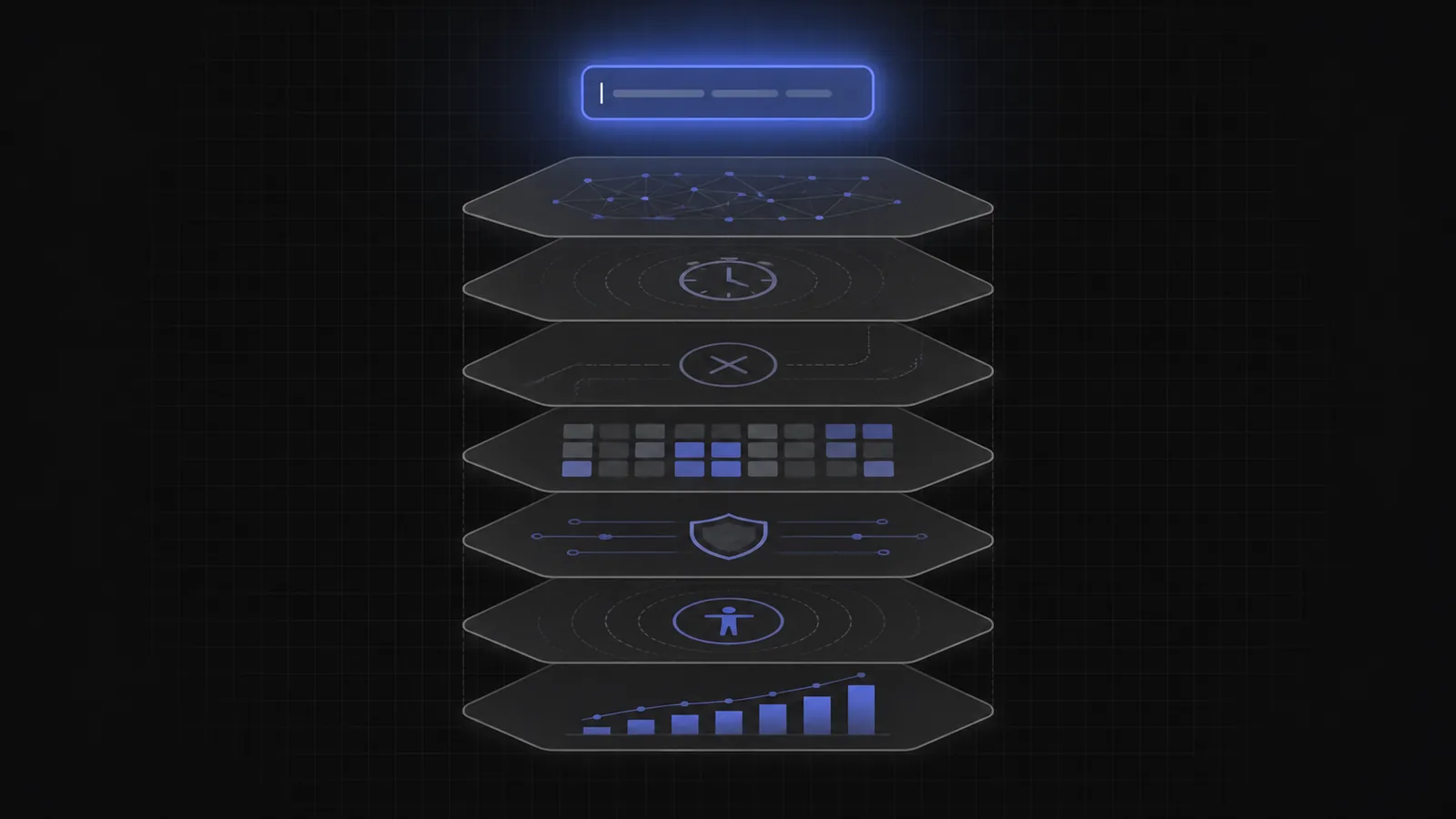
Build-vs-buy discussions often compare an API price with the cost of one model call. That comparison leaves out the product wrapped around the model: request shaping, latency control, state, evaluation, auth, caching, interface behavior, and the work of operating all of it.
Buying is not automatically cheaper, and building is not automatically more strategic. The right choice depends on whether autocomplete is core intellectual property, how unusual the interaction must be, and whether the team wants to own the system after launch.
The hard part of AI autocomplete is not generating one completion. It is making thousands of partial requests feel like one reliable interface.
Define the production system before pricing the build
The visible feature is a text box and a dropdown. Beneath it, a production implementation needs several connected systems. If any one is omitted from the estimate, the internal option will look cheaper than it is.
At minimum, include:
- Intent and quality: prompt or model logic, product context, structured fields, live options, safety rules, and an evaluation set.
- Real-time transport: debouncing, cancellation, stale-response protection, caching, fallbacks, rate limits, and latency monitoring.
- Client interaction: focus, selection, editing, keyboard navigation, mobile behavior, loading, errors, accessibility, and design-system integration.
- Operations: keys and tokens, tenant isolation, observability, analytics, abuse controls, releases, incident response, and ongoing model changes.
The list is not an argument against building. It is the scope of what is being built. A fair estimate includes the first implementation, the platform work that multiple teams may share, and the recurring ownership after the original engineer moves on.
Per-keystroke AI has a different engineering shape
A chat request can wait a second and still feel normal. Autocomplete interrupts the act of typing. Suggestions that arrive late are not merely slow; they can apply to an older query, move the active option, or cause the user to select something that no longer matches the text.
The client has to cancel or ignore old work, preserve completed parameters while text changes, decide when to open and close the dropdown, and handle a response arriving after another response. The server has to keep latency and cost low enough for repeated calls and unpredictable typing bursts.
A late chat answer is annoying. A late autocomplete answer can be wrong for the text currently on screen.
Caching helps, but intent is contextual. The system must know which parts of a request are reusable, which depend on the tenant or user, and which options must stay live. A naive cache can make the interface fast and incorrect.
Building makes sense when ownership creates lasting advantage
An internal build can be right when the interaction is central to the product, the team has deep search or real-time UI expertise, the data or deployment model cannot use a hosted service, or the intent engine itself is proprietary and expected to differentiate the company for years.
The strongest build case includes people who will own evaluation, client libraries, infrastructure, security, and product analytics—not only a prototype. It also includes enough usage to justify fixed engineering and operational cost, plus requirements a vendor genuinely cannot meet.
Build selectively when possible. A company may own its custom input surface and use an API for intent generation, or use an SDK but inject proprietary product fields and option logic. The API vs SDK guide describes those boundaries.
Buying makes sense when the capability should compound elsewhere
A managed system is attractive when the team wants to validate the user value quickly, standard interaction behavior is acceptable, several platforms need supported clients, or the internal roadmap has better places to spend search, infrastructure, and accessibility expertise.
Evaluate the vendor as a production dependency. Test latency at realistic geography and concurrency, structured output quality, runtime data, accessibility, auth modes, data handling, rate limits, observability, customization, export paths, incident history, pricing at expected usage, and what happens if the service is unavailable.
Run the decision against cost per successful outcome, not cost per request. Include engineering time, infrastructure, model usage, support, on-call, failed tasks, and the opportunity cost of delaying the feature. Then revisit the choice when usage, requirements, or team capabilities change.
A fair build-vs-buy decision
- Price the production system, not the model call.
- Autocomplete needs real-time state and latency engineering that chat prototypes can avoid.
- Build when ownership is durable advantage and the team can support the whole surface.
- Buy when speed, supported interaction, and displaced roadmap work matter more than owning the plumbing.
- Hybrid boundaries are normal. Own the distinctive layer and buy the commodity layer.
Frequently asked questions
How hard is it to build AI autocomplete?
A prototype is straightforward. Production difficulty comes from low latency, request cancellation, stale responses, structured state, live data, accessibility, authentication, evaluation, analytics, and ongoing operations.
When should a company build its own?
Build when autocomplete is core product IP, requirements are genuinely unusual, hosted deployment is impossible, or usage and in-house expertise justify sustained ownership across model, infrastructure, and client layers.
When should a company buy?
Buy when the goal is to ship and validate quickly, standard SDK or API boundaries fit, and the team would create more value in the domain experience than in maintaining autocomplete infrastructure.
What should a vendor evaluation include?
Test realistic latency, quality on real partial inputs, structured fields, runtime data, accessibility, auth, privacy, tenant isolation, reliability, rate limits, observability, customization, pricing, support, and failure behavior.
Can we use a hybrid approach?
Yes. Common boundaries include a custom UI on a managed API, a managed SDK with proprietary runtime options, or an internal orchestration layer that routes between autocomplete, search suggestions, and direct retrieval.
Build the advantage, not the plumbing by habit
Make the ownership boundary explicit before comparing costs.
Start with the SDK and API documentation, or review enterprise options for custom requirements.