Thousands of products use Algolia or Elasticsearch to power fast, relevant search. If yours is one of them, your retrieval layer is already in good shape: queries go in, ranked results come out in milliseconds.
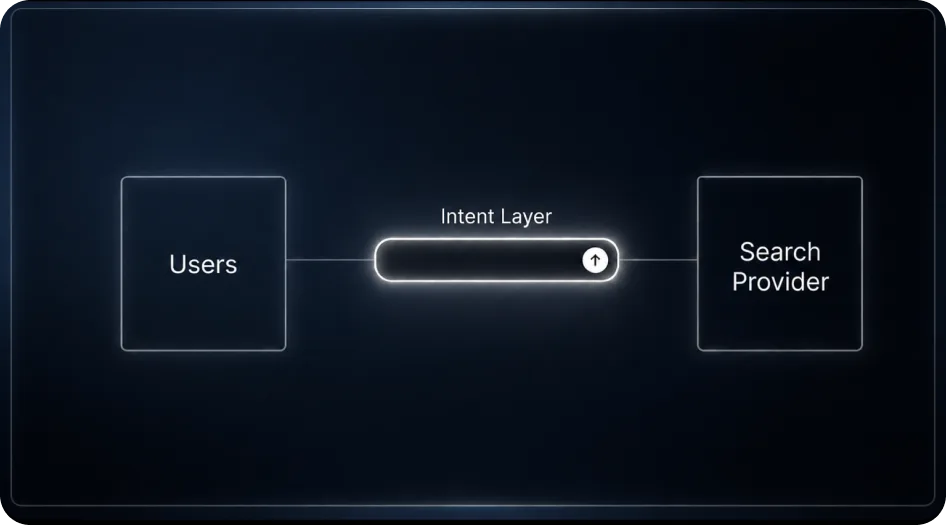
AI Autocomplete works on the other side of that equation, inside the text box itself, before a query is ever submitted. It is an intent layer, not a search engine, so it complements your search backend rather than replacing it.
What Algolia and Elasticsearch do: retrieval and ranking
Algolia and Elasticsearch take a query and find the best matches in your index, handling typos, applying filters and facets, and ranking results by relevance and business rules. The better the query they receive (more terms, more structure, clearer constraints), the better their results get.
That last part is the catch. A search engine can only rank what the user manages to type, and most users type very little.
What AI autocomplete adds: intent capture
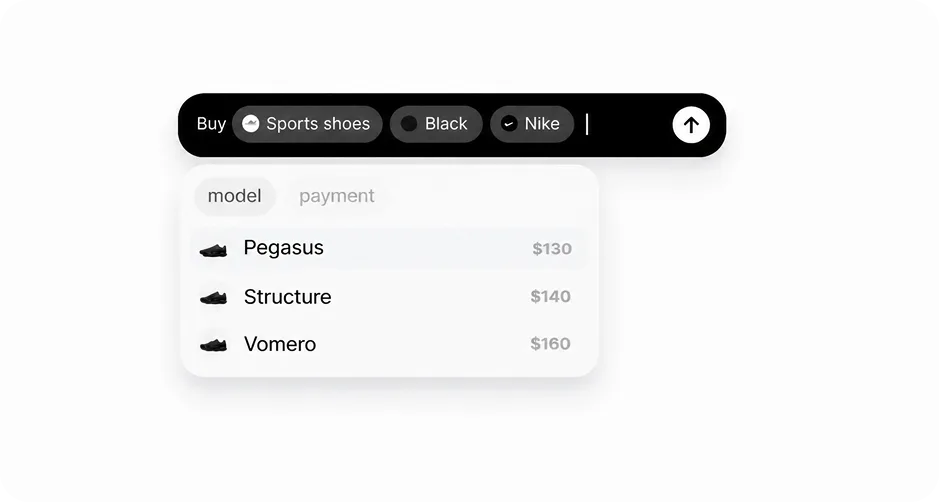
Most queries arrive underspecified. A shopper types “shoes” when they mean black Nike running shoes under $150, deliverable by Friday. The search engine is left to guess everything the user didn't say. We call this the blank text box problem.
AI Autocomplete solves it while the user types. It suggests the choices that matter next (category, brand, color, budget, delivery), drawn from your own product data, and captures every selection as structured fields rather than loose text.
How the two layers work together
The flow is simple. The user types in one text box. AI Autocomplete guides them to a complete, structured request. That structure maps directly onto the search primitives you already use: the free-text part becomes the query, and the captured fields become filters and facets.
“black Nike running shoes under $150” → query: running shoes · brand: Nike · color: black · price < 150
Algolia or Elasticsearch then does what it does best, with a far richer query than a user would ever type unaided. Results improve without touching your index, your ranking rules, or your backend; the gain comes entirely from better input.
Set it up in minutes
The AI Autocomplete SDK drops into your existing search box alongside your Algolia or Elasticsearch integration, and the documentation walks through the five-minute setup. Connect your catalog (categories, brands, prices, inventory) so every suggestion reflects real data, then pass the structured output to your search engine exactly as you build queries today.
Pricing is usage-based, and you can start free. Teams with custom requirements can look at the enterprise options.
Key takeaways
- Complementary, not a replacement. Algolia and Elasticsearch keep doing retrieval and ranking. AI Autocomplete improves what reaches them.
- Two layers, two jobs. Input and intent happen before submit. Retrieval and ranking happen after. Different failure modes, different fixes.
- No index to build or sync. AI Autocomplete works from product context, not a stored dataset, so there's nothing to re-index.
- Small integration surface. Drop the SDK into the text box, pass a structured query to your existing search call on submit. That's it.
- Worth it when the problem is vague queries and abandoned sessions, not slow or poorly ranked retrieval on queries that were already well-formed.
Frequently asked questions
Does AI Autocomplete replace Algolia or Elasticsearch?
No. AI Autocomplete is complementary, not a replacement. Algolia and Elasticsearch still own retrieval and ranking: given a query, they find and return the matching records. AI Autocomplete's job happens earlier. See the full comparison with Algolia and Elasticsearch autocomplete.
How long does it take to add AI Autocomplete to an existing search box?
Most teams drop the SDK into the existing search input and pass the resulting structured query to their current Algolia or Elasticsearch call, without touching the retrieval integration itself. Because there's no index to build, the typical scope is a front-end change plus one call-site update, not a backend migration.
What does AI Autocomplete send to Algolia or Elasticsearch?
A more complete, structured version of what the user was trying to say: a refined query string plus filters such as category, size, price range, or other attributes, gathered from what the user typed and any product context you provide. Your search engine still receives a normal query and filter set through its existing API. It just receives a better one.
When is it worth adding AI Autocomplete on top of an existing search engine?
It's worth adding when the complaint is about what users type rather than what the index returns: vague or one-word queries, empty result pages on well-indexed catalogs, and sessions where users search once and leave. If your queries are already specific and well-formed and results are still poor, that points to a retrieval or ranking problem instead.
Give your search box a brain
Better input is the cheapest search upgrade you can ship. Keep Algolia or Elasticsearch doing what it does best, and let AI Autocomplete make sure it always gets a great query.
Try it at AI-Autocomplete.com