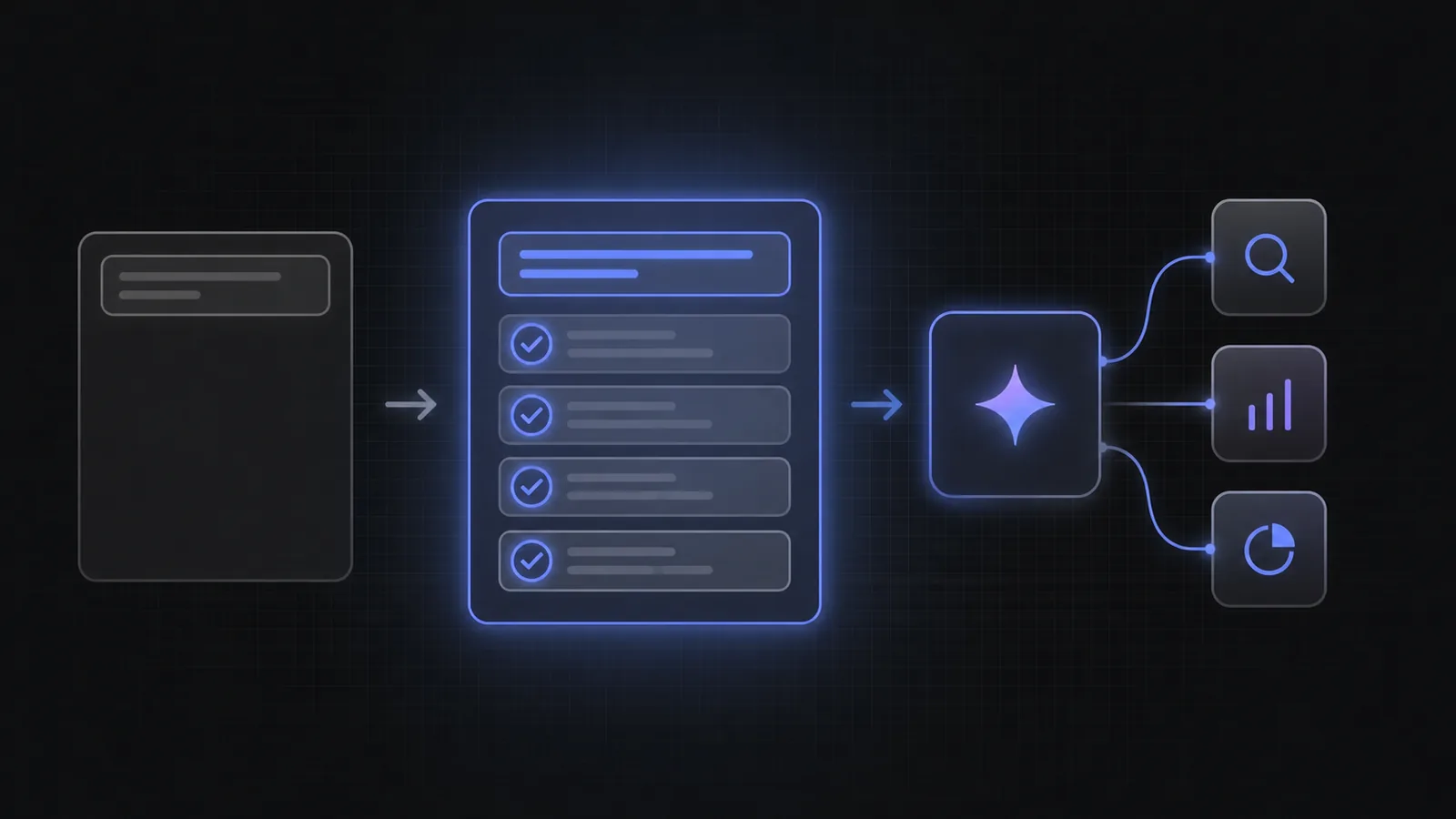
A user types “build a sales dashboard.” The agent could choose a framework, invent a data source, assume the audience, decide which metrics matter, and produce a polished answer to the wrong problem. Or it could stop and ask six questions before doing anything.
AI Autocomplete offers a third path. It helps the user add the missing decisions inside the original text box, then hands the agent a task that is ready to execute.
The best place to reduce agent rework is before the first tool call.
A runnable task needs more than a goal
A short prompt can name the destination without defining the route. For an agent, the missing information often determines which tools it may use, what it is allowed to change, how success will be judged, and when it should stop.
A useful first brief usually covers four things:
- Outcome: the concrete artifact, decision, or state the user wants at the end.
- Context: the product, audience, data, prior work, and current environment.
- Constraints: budget, deadline, permissions, tools, scope, quality bar, and things that must not change.
- Delivery: format, destination, review step, and what counts as done.
Not every task needs every field. A good intent layer responds to the task that is forming. “Summarize this file” may be complete already. “Launch a paid campaign” needs far more context and an explicit boundary around external actions.
Clarification after submit is still work
Chat makes follow-up questions possible, but a possible recovery path is not the same as a good starting point. Each turn adds latency, model usage, and another chance for the user to leave. Worse, some agents act before they recognize what is missing.
AI Autocomplete can surface the most consequential choices while the user still has the prompt in mind. The interaction stays lightweight: type naturally, accept useful options, ignore irrelevant ones, and submit when the request is complete enough.
Goal + context + constraints + delivery is a brief. A goal by itself is only a direction.
This does not eliminate conversation. Agents will still encounter ambiguity, changing state, and decisions that require approval. It removes predictable clarification that the interface could have handled before execution began.
Structure helps the agent choose tools and respect boundaries
A completed request can remain readable natural language and also carry structured parameters. The user sees a coherent sentence. The agent receives explicit fields for repository, environment, audience, output type, allowed tools, or approval requirements.
Those fields can influence routing before the main agent loop runs. A research task can open the retrieval path. A code task can select the correct workspace. A request involving email, money, deletion, or production can enter a flow that requires confirmation rather than relying on the model to notice the risk halfway through.
The intent layer should not grant permission by itself. It captures what the user asked for and makes boundaries visible; the agent's authorization and confirmation system still decides what may happen. Better input supports safety, but does not replace it.
Design the autocomplete from failed runs, not imagined prompts
Start with the agent's history. Review tasks that required repeated clarification, chose the wrong tool, produced the wrong artifact, or had to be restarted. Identify the missing facts that would have prevented each failure.
Turn the recurring, high-value facts into fields the interface can suggest. Keep the set small. If every possible decision becomes a chip, the text box turns into the form it was meant to improve. Fields should appear only when the emerging intent makes them useful.
Measure time to first useful output, clarification turns, reruns, tool-call errors, task completion, human corrections, and cost per completed task. The API and SDK guide explains how to choose the integration surface, and the docs show how completed parameters reach the application.
What the intent layer does for agents
- It turns a goal into a runnable brief before the first model or tool call.
- It reduces predictable clarification, without pretending all ambiguity can disappear.
- It gives routing and guardrails explicit fields instead of asking them to infer everything from prose.
- It preserves natural language. The user writes normally and adds structure only where it helps.
- It should be designed from real failed runs and measured by completed tasks, not prompt length.
Frequently asked questions
What is AI autocomplete for agents?
It is an intent layer inside the agent's input. It helps users specify the outcome, context, constraints, and delivery details before the agent starts working.
Does it replace an agent's follow-up questions?
It can remove common, predictable follow-ups. The agent may still need to ask about changing state, conflicting instructions, approvals, or choices that only become visible during execution.
Can structured fields improve tool selection?
Yes. Explicit fields such as task type, repository, platform, data source, or output can support deterministic routing before or alongside model-based decisions.
Is a longer prompt always better for an agent?
No. A good brief is complete, not bloated. Irrelevant detail adds noise. The interface should ask only for information that changes execution or the definition of success.
Which agent tasks benefit most?
Multi-step, expensive, or consequential tasks benefit most: software changes, research, campaign creation, data analysis, design production, travel planning, procurement, and workflows that call external tools.
Give the agent the decisions before the work
A better first brief is faster than a better recovery.
Explore the benefits of AI Autocomplete or build the first integration from the documentation.