Traditional autocomplete predicts the next keyword from historical data. This usually results in a two or three word search.
AI Autocomplete predicts everything the user may want to do based on their real-time intent and what the product can do. This results in richer searches, less back and forth, and lower costs.
Traditional autocomplete



AI Autocomplete
How traditional autocomplete and AI Autocomplete work
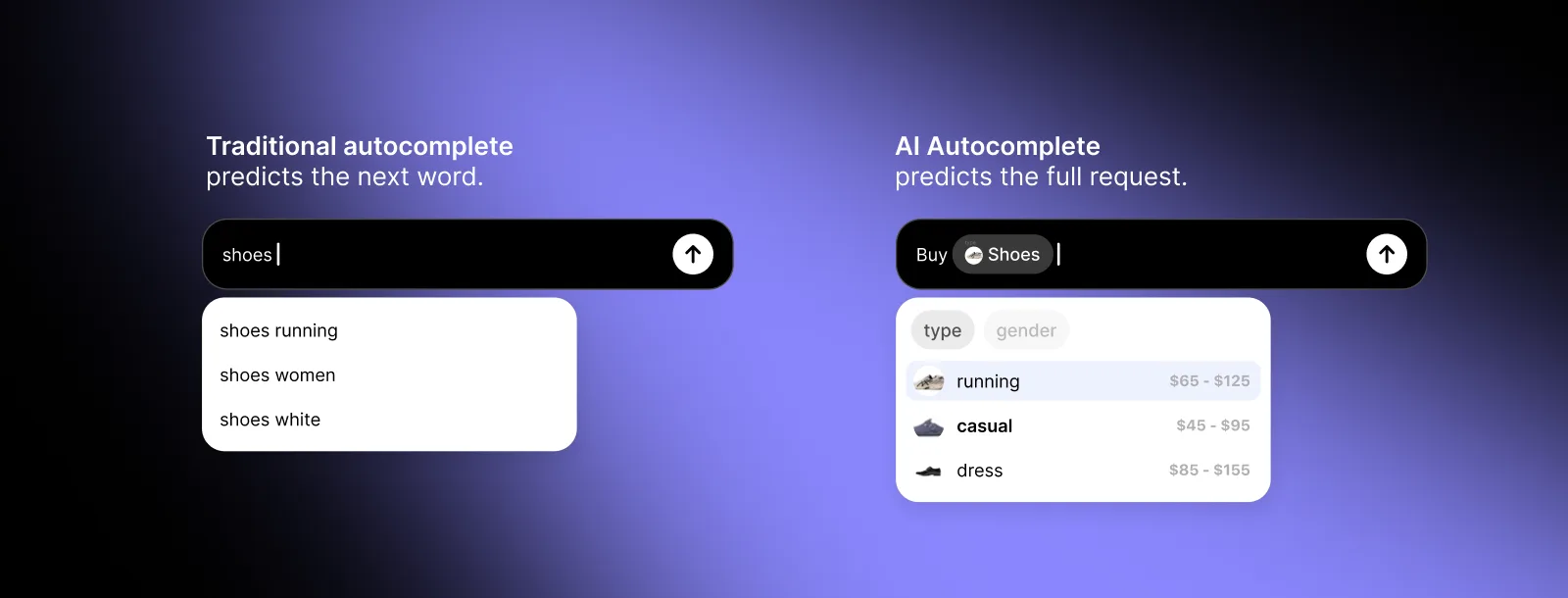
Traditional autocomplete predicts the next word
Traditional autocomplete looks at what the user has typed and compares it with historical keywords and popular searches.
User types → the system finds a matching historical phrase → it predicts the next keyword
For example: "run" → "running shoes". The result is usually a slightly longer version of what the user already typed.
AI Autocomplete predicts the full request
AI Autocomplete predicts the full request by understanding the user's real-time intent, the current context, and every action available inside the product.
User types → AI Autocomplete predicts the actions they may want to take → it helps them add the details needed to complete the request
For example: "running shoes" → "women's waterproof trail shoes, size 8, under $150".
The existing search engine, chatbot, or agent still handles the completed request. AI Autocomplete makes the request much better before it is submitted.
The result: richer searches, faster experiences, and lower costs
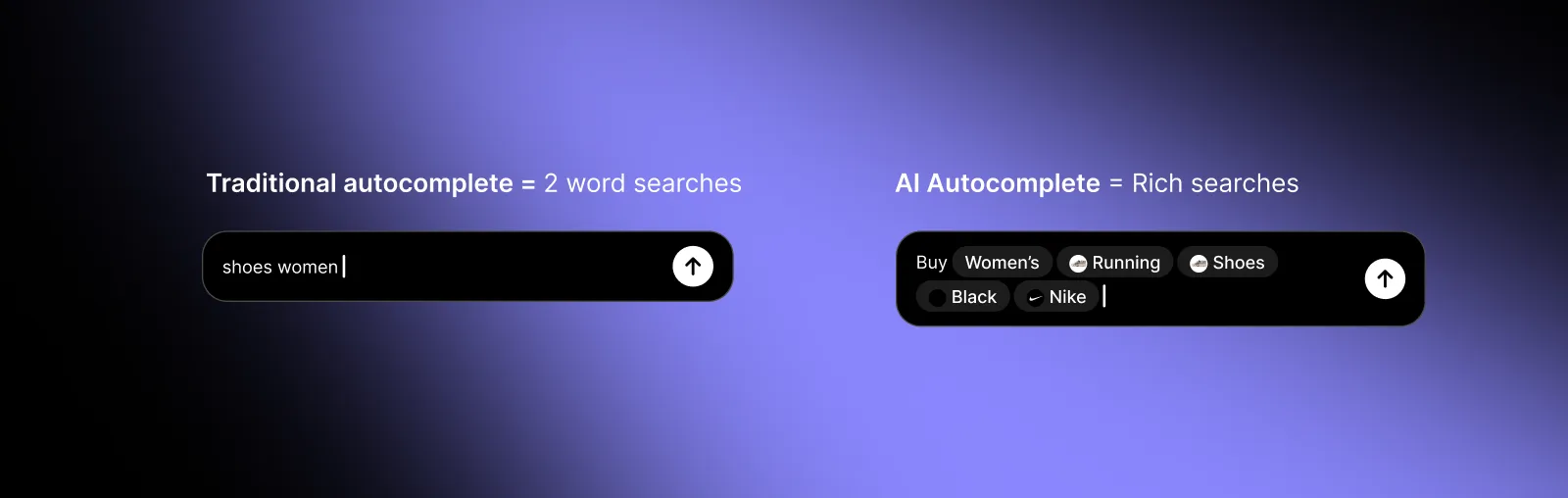
Richer searches
Most users know more about what they want than they express in the two or three words they normally type.
Traditional autocomplete may help a shopper change "black" into "black dress". AI Autocomplete can help the shopper create a complete search:
"black dress" → "black midi dress for a summer wedding, size 6, under $200, available by Friday"
The user gets better results because the search engine receives a much richer request.
A faster user experience
A richer request helps the product get to the right answer faster. Instead of searching, changing filters, trying again, and answering several follow-up questions, the user can provide the important details while they type.
This means fewer steps and less back and forth.
Lower costs
Complete requests also require less work from chatbots and AI agents. When the important details are collected before submission, the system needs fewer clarification questions and fewer model calls.
That creates a faster experience for the user and a lower cost for the product.
Key takeaways
- AI Autocomplete is far more powerful because it predicts the full request, not just the next keyword.
- Better inputs. Traditional autocomplete runs on prefixes and search history. AI Autocomplete runs on your product's capabilities, connected data, and current intent.
- Clear example: "run" → "running shoes" is a completed phrase. "running shoes" → a full request with size, use case, and budget is a completed action.
- The impact shows up downstream. Incomplete requests mean generic results and more agent follow-up questions. Complete requests mean less back and forth, higher conversions, and lower costs.
- AI Autocomplete is the layer before your search or agent provider. It sits before your existing search engine, chatbot, or agent, and improves what reaches it.
Frequently asked questions
What is the difference between traditional autocomplete and AI Autocomplete?
AI Autocomplete is the evolution of traditional autocomplete. Traditional autocomplete predicts the next word: type "run" and it may suggest "running shoes". AI Autocomplete predicts the full request: type "running shoes" and it can help create a structured request such as "women's waterproof trail shoes, size 8, under $150".
Does AI Autocomplete replace traditional autocomplete?
Yes. AI Autocomplete can replace the traditional autocomplete layer because it does the same basic job and goes much further. Instead of only predicting the next word, it predicts the full request so the product has enough detail to act. It does not replace the search engine, chatbot, or agent that handles the completed request.
Why is traditional autocomplete less useful for complex products?
Traditional autocomplete only extends a prefix into a likely phrase. It does not understand which details are needed to complete the request, such as size, budget, use case, dates, or delivery requirements. That often leads to vague searches, generic results, more filtering, and follow-up questions.
What information does AI Autocomplete use?
AI Autocomplete uses the user's real-time intent, the current context, and what the product can do. It can also use connected product data such as categories, prices, inventory, available actions, and custom fields to predict a complete request.
Where does AI Autocomplete fit if I already have search or an AI agent?
Before it. AI Autocomplete sits inside the text box and completes the request before submit. Your existing search engine, chatbot, or agent then handles the richer request as usual. See how it works with an Algolia or Elasticsearch backend.
Give your text box a brain
The fastest upgrade from traditional autocomplete is the layer that completes the whole request. Drop it into your existing text box and keep your search, chat, or agent stack exactly as it is.
Try it at AI-Autocomplete.com