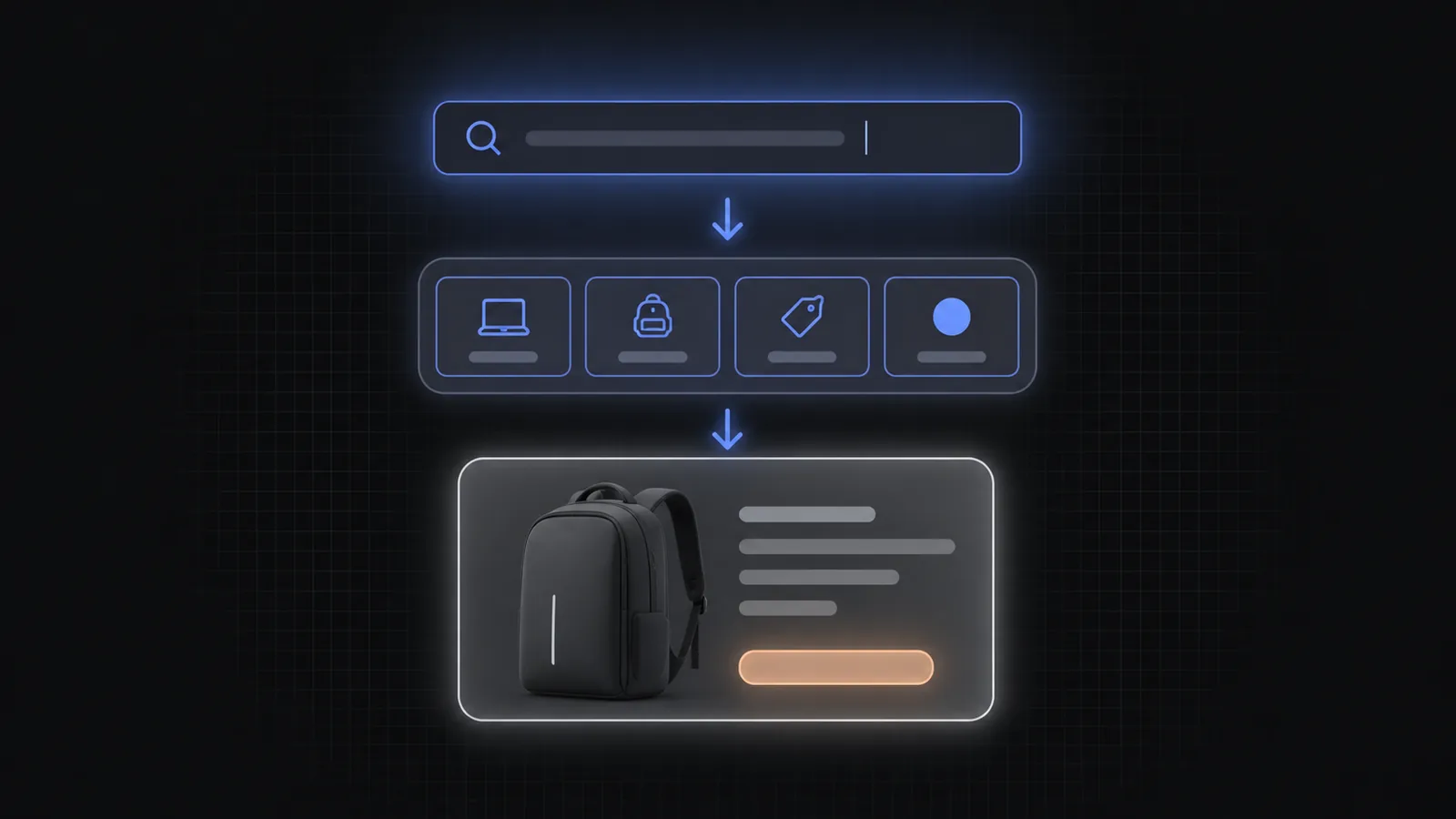
Consider the query “black bag.” It could mean a work backpack that fits a laptop, an evening bag for a wedding, a carry-on for an international flight, or a school bag under $60 that arrives tomorrow. The shopper knows more than the query says.
Traditional ecommerce autocomplete usually suggests a longer phrase, a category, or a product that matches the prefix. AI Autocomplete can go further: it helps the shopper build the whole buying request inside the search box.
Ecommerce search improves when the box captures buying intent, not merely more keywords.
Buying intent is a bundle of constraints
Product discovery rarely depends on one attribute. A good match sits at the intersection of what the item is, where or why it will be used, what the shopper prefers, and what the store can actually supply.
For most catalogs, the useful request contains some combination of four kinds of information:
- Product: category, use, material, style, brand, or model.
- Fit: size, compatibility, dimensions, audience, or technical requirements.
- Commercial constraints: price, stock, delivery date, seller, condition, or payment option.
- Context: the trip, room, weather, event, recipient, or problem the product is for.
Facets can represent many of these details, but facets normally wait on the results page. AI Autocomplete brings the relevant ones into the typing flow, so the shopper can express intent without knowing the catalog schema or opening a filter drawer.
Complete the request before showing the result wall
The usual ecommerce journey submits the vague query first and repairs it afterward. The shopper searches, scans a mixed result set, opens filters, learns the store's vocabulary, applies constraints, and repeats. On mobile, every one of those steps competes for limited space.
AI Autocomplete changes the order. As the shopper types, the interface can surface the next useful choice from live catalog data—category, size, color, price, inventory, delivery, or any store-specific field. Each selection becomes part of the request before results are fetched.
“running shoes” becomes “women's waterproof trail shoes, size 8, under $150, available by Friday” before the first result page loads.
The point is not to make every query long. The point is to make every added detail earn its place. A known shopper looking for a specific SKU should still move quickly. A broad shopper with a multi-part need should get help forming the request.
Keep the search engine and catalog you already have
AI Autocomplete is an input layer. It does not need to own product indexing, ranking, merchandising, recommendations, or the results page. The completed free text can become the query, while captured fields map to the filters and facets the store already uses.
That makes the architecture deliberately boring: shopper types → AI Autocomplete completes the intent → the existing search provider retrieves and ranks. Inventory, price, and availability can be injected at runtime so the interface does not suggest an option the store cannot fulfill.
Teams using Algolia, Elasticsearch, Typesense, Meilisearch, or a custom service can keep their current backend. The integration guide for Algolia and Elasticsearch shows the same two-layer pattern, and the provider comparison covers the broader category.
Measure the shopping journey, not the suggestion menu
Autocomplete click-through is useful, but it is not the business outcome. A suggestion can attract a click and still lead to irrelevant products. The stronger measures are what happens after the completed request reaches search.
Track search-to-product-view rate, reformulation, filter use, zero-result rate, add-to-cart rate, conversion, time to product, and revenue per search session. Segment new and returning shoppers; someone who knows the exact product should not be judged by the same path as someone shopping by occasion.
AI Autocomplete is most valuable where the catalog is broad, the decision has several constraints, and vague searches are common. It is less important for a tiny catalog or a store dominated by exact SKU lookups. The test is simple: if better-specified queries already perform well, improving input has leverage.
What AI Autocomplete changes in ecommerce
- It captures the request shoppers mean, not only the fragment they initially type.
- It moves useful facets before submit, reducing the work required on the results page.
- It can use live catalog context, including price, inventory, delivery, and store-specific fields.
- It complements the search stack. Indexing, ranking, merchandising, and results stay where they are.
- It should be judged by product discovery and conversion, not suggestion clicks alone.
Frequently asked questions
What is AI autocomplete for ecommerce?
It is an intent-capture layer inside the commerce search box. It helps shoppers add relevant product attributes and constraints before submitting, then passes the completed query to the existing search or recommendation system.
Does AI autocomplete replace ecommerce search?
No. It improves the input. The search engine still indexes products, applies business rules, retrieves matches, ranks results, and renders the results page.
Can it use current inventory and pricing?
Yes. Product fields and option lists can come from current application data, so suggestions can reflect the catalog, price, inventory, delivery, location, or other constraints the store exposes.
How is it different from predictive search?
Predictive search commonly suggests popular queries, categories, or products that match the prefix. AI autocomplete helps construct a complete request from the shopper's intent and several connected attributes. The search technology guide compares the approaches directly.
Which ecommerce categories benefit most?
Categories with broad assortments and multi-attribute decisions tend to benefit most: fashion, electronics, home, beauty, travel, automotive, gifts, marketplaces, and B2B catalogs. Exact-SKU catalogs may need less guidance.
Let shoppers search the way they think
Keep the catalog and ranking logic. Give them a request with enough detail to work.
See the SDK and API documentation or review pricing.