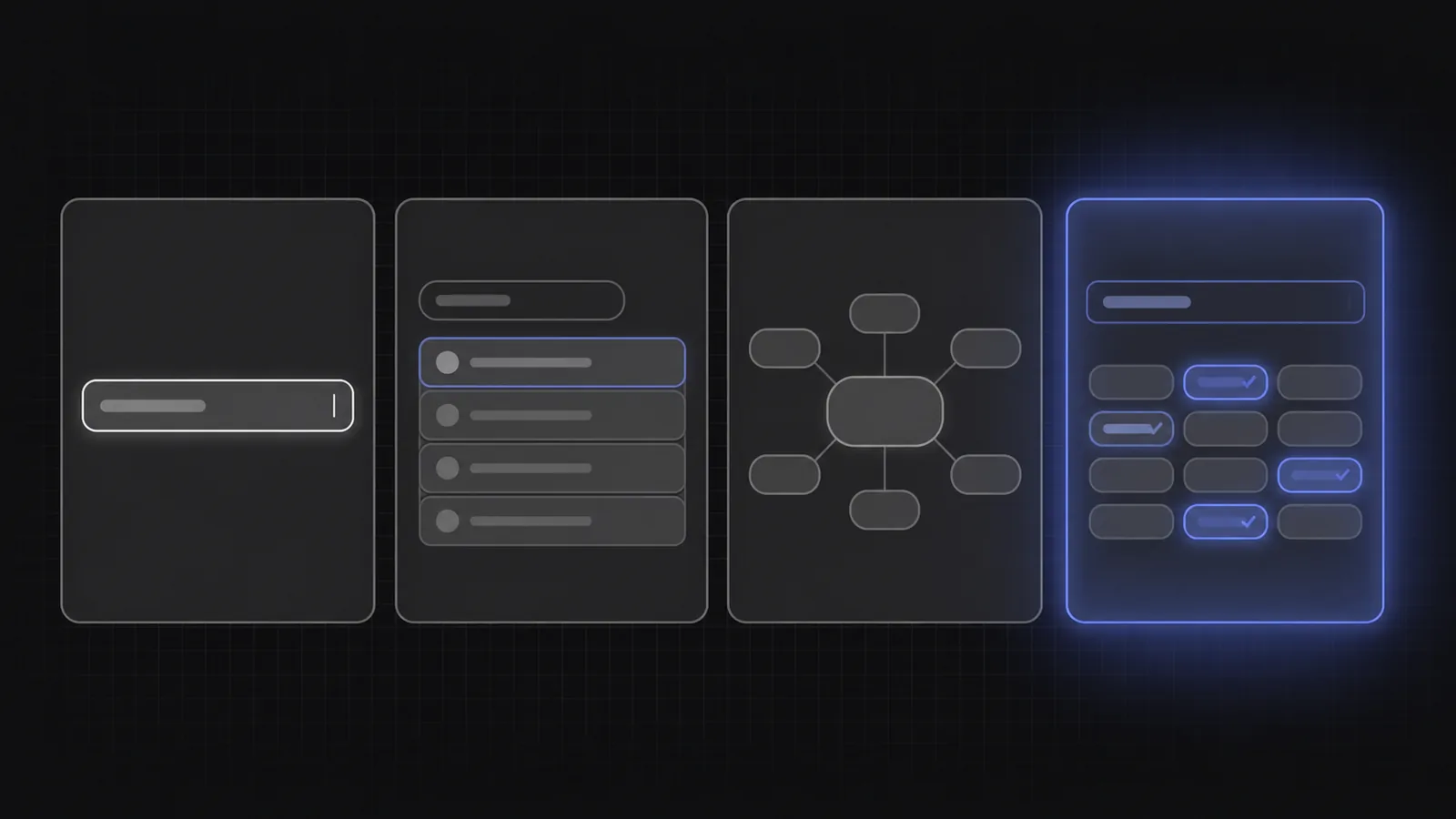
A modern search box may complete text, display records while the user types, retrieve by meaning, and help assemble a structured request. Those experiences can look similar from the outside. Underneath, they solve four separate problems.
Choosing the wrong name is not merely a language problem. It leads teams to buy the wrong layer, measure the wrong outcome, or expect retrieval technology to fix an incomplete request.
Search suggestions predict a query. Search-as-you-type returns records. Semantic search matches meaning. AI Autocomplete completes intent.
Four technologies, four jobs
The useful comparison begins with the output. Ask what the system returns after each keystroke or after submit. That answer places the technology in the stack.
Here is the compact definition of each category:
- Search suggestions: candidate queries, often generated from popular searches, indexed phrases, categories, history, or editorial rules.
- Search-as-you-type: matching records that update as the query prefix changes.
- Semantic search: records whose meaning is related to the submitted query, often using embeddings or a hybrid lexical-semantic score.
- AI Autocomplete: the rest of the user's request, including relevant choices and structured parameters, before submit.
A fifth term, predictive search, is used loosely. Some products use it for query suggestions; others use it for live product results or a mixed autocomplete panel. Read the behavior, not the label.
The timing boundary makes the difference obvious
Search suggestions, search-as-you-type, and AI Autocomplete all react during typing. Semantic search usually becomes visible as retrieval—either after submit or in a live result list that re-runs semantic or hybrid search with each change.
AI Autocomplete is different because its primary object is the request itself. It can ask the user to choose the category, audience, budget, date, format, or action needed to make the request complete. Search technologies primarily use the current query to find a phrase or record.
Before submit: complete the request. After submit: retrieve and rank the answer.
That boundary is the same whether the downstream system is lexical search, semantic search, a chatbot, or an agent. The intent-layer guide explains why AI Autocomplete belongs before each of them.
The technologies work better together than as substitutes
A commerce box can show popular query suggestions for navigational shortcuts, live product results for known-item search, and AI Autocomplete choices for a broad multi-constraint request. The completed query can then run through hybrid semantic and lexical retrieval.
The product does not need to force every keystroke through every layer. An exact SKU can go straight to results. A familiar branded query can use a fast suggestion. A vague request can open the intent flow. A long natural-language query can benefit from semantic retrieval after submit.
Routing by request shape keeps the experience fast and legible. It also makes measurement honest: suggestion selection, record click, intent completion, and retrieval success are different events and should not be collapsed into one autocomplete metric.
Choose the layer from the failure you are trying to fix
Use search suggestions when people know the destination but type slowly, make spelling errors, or benefit from popular shortcuts. Use search-as-you-type when immediate matching records help users recognize the right item before they finish the query.
Use semantic search when the submitted words and the relevant record do not share the same vocabulary. Use AI Autocomplete when the user has not yet expressed enough of the goal or constraints for any retrieval system to do its best work.
Many products need more than one. The architecture stays clean when each layer has a named job, a defined input and output, and its own success measure. The search autocomplete provider comparison applies this taxonomy to the main vendor categories.
The shortest useful distinction
- Search suggestions return queries.
- Search-as-you-type returns records during typing.
- Semantic search returns records by meaning.
- AI Autocomplete returns a more complete request.
- These layers can coexist. Pick them from the user failure, not the marketing term.
Frequently asked questions
Is search-as-you-type the same as autocomplete?
Sometimes products use the terms interchangeably, but the behaviors differ. Search-as-you-type usually updates matching records; autocomplete may suggest a query, complete text, or help complete intent.
Is AI autocomplete a type of semantic search?
No. Semantic search retrieves records by meaning. AI autocomplete helps create the request that will be sent to retrieval. A completed request can then be searched semantically.
What is the difference between query suggestions and AI autocomplete?
Query suggestions commonly offer known or popular searches related to the current prefix. AI autocomplete can introduce the fields and choices required to complete the user's specific request, even when that request has not appeared before.
Can one search box use all four technologies?
Yes, but the UI should not expose all behaviors at once without hierarchy. Route by intent and query shape, and keep the dropdown clear about whether an item is a query, a record, or a field choice.
Which technology should we implement first?
Start with the dominant failure. Use suggestions for typing and navigation problems, search-as-you-type for recognition, semantic search for vocabulary mismatch, and AI autocomplete for incomplete requests.
Name the problem before choosing the search technology
The text box may need a shortcut, a result, better retrieval, or a better request. Those are not the same project.
Continue with traditional autocomplete vs AI Autocomplete or see the implementation options.