When a user types “benefits,” do they want employee benefits, product advantages, an account policy, or a comparison page? A search engine can retrieve each of those. It cannot know which one the user meant unless the query or surrounding context says more.
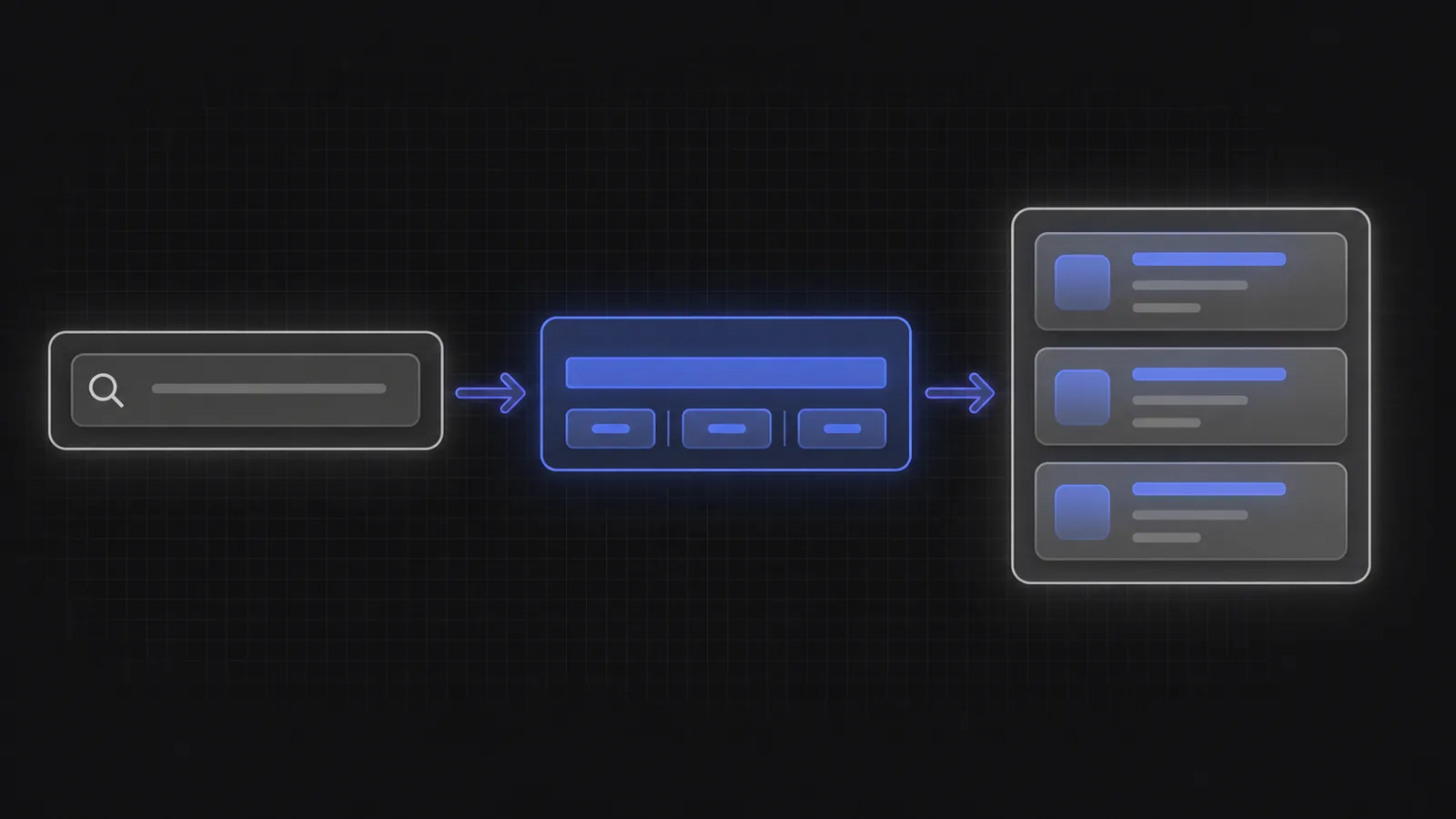
AI Autocomplete sits before retrieval. It helps the user specify the subject, goal, constraints, and scope while typing, then hands the existing site-search system a query it can rank with confidence.
Search relevance is not only a ranking problem. It is also an input problem.
Recognize an input problem before rebuilding search
Bad results are often blamed on the engine because that is where the failure becomes visible. The cause may be earlier. If the same index performs well when an employee tests a precise query but poorly when visitors type one or two broad words, the retrieval layer may be doing exactly what it was asked to do.
Four signals point to weak input rather than weak retrieval:
- Successful internal test queries are much longer or more specific than real user queries.
- Visitors reformulate immediately, add several filters, or bounce after one broad search.
- Zero-result pages come from missing context or vocabulary, not missing indexed content.
- Support logs show that users can describe the need in conversation, but not in the search box.
Those patterns do not prove ranking is perfect. They show that ranking and input need separate diagnoses. Fixing synonyms, embeddings, or relevance weights will not reliably recover details the visitor never expressed.
Capture intent while the query is still editable
Conventional search autocomplete helps users type less. It may complete a known phrase, suggest a popular query, display a category, or show matching records. Those are useful shortcuts, especially for navigational search.
AI Autocomplete handles a different case: the visitor knows the goal but has not yet formed the right query. It can introduce choices tied to the current intent—content type, audience, time period, product area, location, price, format, or any domain-specific field.
The user should not have to learn the index schema before the search box can understand the request.
A query such as “security docs” can become “SSO configuration docs for a React application using SAML.” A marketplace search such as “designer” can become “freelance product designer in London, available this month, with fintech experience.” The text grows only because the intent becomes more useful.
Map the completed request to ordinary search primitives
The integration does not require a new retrieval theory. Keep the natural-language portion as the query. Map completed fields to filters, facets, boosts, routing rules, or query parameters already supported by the search backend.
For Algolia, that may be a query plus facet filters. For Elasticsearch, it may be a multi-match query plus bool filters. For Typesense or Meilisearch, it may be a text query plus filter expressions. A custom backend can receive the same shape through its existing endpoint.
This separation is important. AI Autocomplete owns the request before submit; search owns retrieval and ranking after submit. The two-layer integration guide shows the flow in detail. If those jobs are collapsed into one black box, debugging becomes harder.
Judge the system by downstream search behavior
A good experiment starts with a narrow surface and a clear baseline. Choose a search box where queries are routinely vague, define the fields that separate a useful request from a weak one, and compare sessions with and without intent guidance.
Measure query specificity, reformulation rate, zero results, result clicks, time to first useful click, filter usage, search exits, and the action that matters after discovery. A longer query is not automatically better; it is better only when it produces a more successful session.
If precise queries still return bad results, work on retrieval. If precise queries perform well but users rarely write them, work on input. Many products need both. The useful insight is knowing which layer is failing before spending months on the wrong one.
A cleaner model for site search
- Input and retrieval are different systems. Diagnose them separately.
- AI Autocomplete improves the query before submit; the search engine still retrieves and ranks afterward.
- Structured intent maps to normal search primitives: query text, filters, facets, boosts, and routing.
- Precise test queries are evidence. If they work and visitor queries do not, input has leverage.
- Success means a better search journey, not merely more suggestion clicks or longer text.
Frequently asked questions
How does AI autocomplete improve site search?
It helps users add the context and constraints that search needs before submitting. The completed text becomes a richer query, and captured fields can become filters or facets in the existing search call.
Is AI autocomplete the same as semantic search?
No. Semantic search finds records whose meaning is related to a submitted query. AI autocomplete helps form the query before it is submitted. They can work together. See the full search technology comparison.
Does it work with an existing search provider?
Yes. It can sit in front of Algolia, Elasticsearch, Typesense, Meilisearch, Coveo, a database search layer, or a custom service. The downstream provider keeps its index and ranking logic.
Will longer queries always improve results?
No. Added detail must correspond to real distinctions in the content or catalog. The goal is not verbosity; it is enough information to retrieve and rank the right result.
When should we improve retrieval instead?
Improve retrieval when complete, well-formed queries still perform badly because of missing content, poor indexing, weak analyzers, incorrect filters, or bad ranking. AI autocomplete cannot repair those issues.
Give search a query worth ranking
Keep the engine. Improve what reaches it.
Read the search provider comparison or start with the implementation docs.